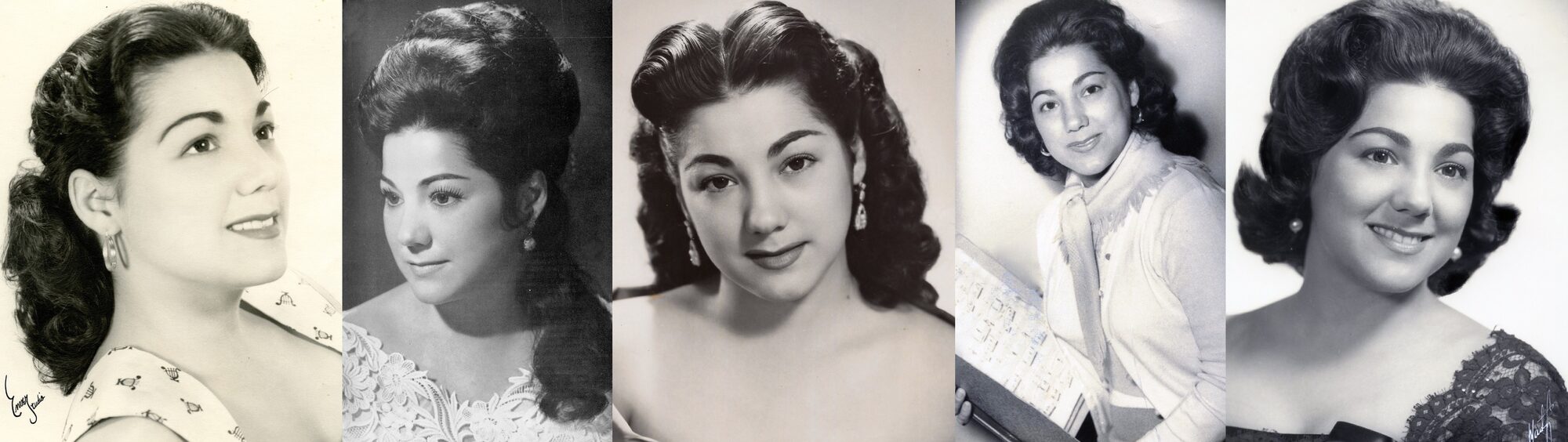
Who was Olga Iglesias?
The soprano who sang Pablo Casals' El Pessebre more than anyone, at Carnegie Hall, the United Nations, and across a world he hoped to move toward peace.
Written by Anthony Cheney Guzmán
Her story, on film
Who was Olga Iglesias, soprano, & her role in Pablo Casals' 'El Pessebre'
Birth & Early Life
Olga Iglesias was born on March 22, 1929 in San Juan, Puerto Rico.
Known as the soprano who most performed in Pablo Casals' magnum opus, El Pessebre, as well as interpreter of his art songs, Olga Iglesias was born on March 22, 1929 in San Juan, Puerto Rico. The youngest of eight children born to Rafael Iglesias Normandín and María Victoria Antoni Rodríguez, Olga Iglesias was exposed to music through her older siblings who played the piano and the violin. Showing talent in singing at an early age, at 14 she began studying with renowned Puerto Rican tenor, Antonio Paoli, while still attending Central High School in Santurce, Puerto Rico. In 1947, Olga Iglesias made her public debut on May 4 at La Fortaleza, the official residence of the governor of Puerto Rico, during the first annual "The Week of Music". During this occasion she sang Verdi's "Caro nome" from Rigoletto and "Ah, fors'è lui" from La Traviata.
Musical Career
Olga returns to Puerto Rico and begins her musical career traversing the island.
After completing musical studies in Philadelphia and New York, a scholarship granted to her by the Puerto Rican government, Olga Iglesias returned to Puerto Rico to begin her musical career in earnest. A musical career that would surprisingly take her on course to work as Pablo Casals' primary choice of soprano for his oratorio of peace, El Pessebre, and his art songs.
Throughout the mid-century, Olga Iglesias traversed the island of Puerto Rico giving concerts and recitals under the auspices of El Instituto de Cultura Puertorriqueña alongside Casals' wife, Marta Montañez, cellist; Luz Hutchinson, pianist; and her husband, Henry Hutchinson, violinist, among other Puerto Rican classical musicians. Of note, in 1956, her debut album hit stores called "You Are Always in My Heart" with José Enrique Pedreira on piano and José Raúl Ramírez on organ, followed in 1959 by another album, "Renadío del Cantar Folclórico Puertorriqueño" with Luz Hutchinson on piano. In addition, Olga Iglesias belonged to the Círculo Operático, a musical group of local operatic singers founded by Puerto Rican soprano, Rina de Toledo, and Puerto Rican pianist, Elsa Rivera Salgado, to promote bel canto and the Puerto Rican repertoire. In addition, Olga Iglesias appeared on many occasions on the local television stations, WIPR-TV, and WAPA-TV, as well as on radio.
Puerto Rico Casals Festival
Debut with the Puerto Rico Symphony Orchestra and selection by Pablo Casals as soloist.
In 1958 Olga Iglesias made her debut as soloist with the Puerto Rico Symphony Orchestra, presented by Festival Casals, Inc., under the direction of Richard Burgin, associate conductor of the Boston Symphony Orchestra. This was the first of multiple performances over decades in which Olga would sing with the orchestra and at the Puerto Rico Casals Festival. In July of 1960, Olga received a letter by renowned violinist and conductor Alexander Schneider, who at the time also held an administrative role at Festival Casals, Inc., the corporation that then administered the festival. Schneider indicated that Pablo Casals had selected her to be the soloist in three concerts Casals was conducting in March of 1961. It was in these performances where she sang Donizetti's "Regnava nel silenzio" from Lucia di Lammermoor and W.A. Mozart's "No, no che non sei capace," K. 419. In 1963, under Pablo Casals' baton, she later went on to Carnegie Hall under the Casals Festival to sing in J.S. Bach's St. Matthew Passion and in 1964 to sing in Haydn's The Creation. These are two of three performances she sang at Carnegie Hall, in addition to many others under the baton of Pablo Casals and at the Puerto Rico Casals Festival.
El Pessebre Around the World
From the American debut in San Francisco to the United Nations and Pablo Casals' native Catalonia, she carried his oratorio of peace farther than any other soprano.
San Francisco United Nations Athens Catalonia Mexico Argentina Venezuela Switzerland France United Kingdom Israel Germany
Beginning in 1960, Pablo Casals began to take his oratorio of peace, El Pessebre, across the world as conductor. Casals used El Pessebre as a vehicle to promote his message of peace. From the American debut in San Francisco in 1962 to its final performances with Casals serving as conductor, Olga Iglesias was the soprano who performed in El Pessebre the most. Such notable performances include the 1963 and 1967 concerts at the United Nations, the Athens Festival in 1966 held at the Herodes Atticus in Athens, Greece, and in Pablo Casals' native land of Catalonia, Spain in 1967. In addition to these, with Olga Iglesias in the soprano role, El Pessebre was also performed in Argentina, Mexico, El Salvador, Venezuela, Switzerland, France, the United Kingdom, Israel, Dominican Republic, Germany, and throughout the USA.
'El Pessebre' by Pablo Casals. What is it about? And why was it so important to Maestro Pau Casals?
Marlboro & Columbia Records
Records Casals' art songs for Columbia Records at the Marlboro Festival.
In 1965, with Rudolf Serkin serving as the artistic director of the Marlboro Music Festival in Marlboro, Vermont, Olga Iglesias received correspondence confirming her participation in said festival. Pablo Casals attended that summer as well, a frequent participant. In the summer of 1966 Olga Iglesias returned to Marlboro once again, this time to record six of Casals' art songs for Columbia Records (now Sony) with Mieczyslaw Horszowski on piano and supervision by the composer, Pablo Casals. This recording is still commercially available today.
Professor & Later Career
Transition to professor and head of the voice department at the Conservatory.
After Pablo Casals' death in 1973, Olga Iglesias continued to perform in the Puerto Rico Casals Festival, to appear with the Symphonic Orchestra of Puerto Rico, and also to continue singing under the patronage of El Instituto de Cultura Puertorriqueña among others. One of her final public concerts was performing at the Kennedy Center in Washington, D.C. in April 1986. Apart from performing, Olga Iglesias belonged to the 1964 first graduating class of the Conservatorio de Música de Puerto Rico, and after completing her post-graduate studies at said institution, she transitioned to the role of professor and ultimately head of the voice department by the mid 1970s.
Legacy
Olga Iglesias' legacy endures through the Olga Iglesias Project.
Olga Iglesias passed away on May 26, 2013 in Hollywood, Florida having contributed to the Pablo Casals legacy as well as to the classical music scene of Puerto Rico. Her recordings and her students carry her voice forward; the Olga Iglesias Project, founded in her name in 2020, now carries it into the island's schools. Surviving her was her high school sweetheart and husband of 63 years, Robert I. Cheney, her only child, Robert I. Cheney Jr., two grandchildren, and one great-grandchild.
Her legacy is a living tradition
Olga Iglesias' voice is preserved in recordings and in the archive, but her legacy is not only history. The Olga Iglesias Project carries it forward, sponsoring a new generation of Puerto Rican singers, bringing educational recitals and children's opera to schools across the island, and stewarding the classical music heritage she helped build.
Every recital, every opera, every new work advances Puerto Rico's classical music heritage.